
IT Email Security

Many cyber threats target email because nearly everyone in developed countries uses email and every email account has extensive connections to other people. A successful breach of one email account can result in an eventual breach of thousands or even millions of other accounts. View our easy to use email security guide below; then discover how you can transform your employees from your weakest link to your first line of defense through security training.

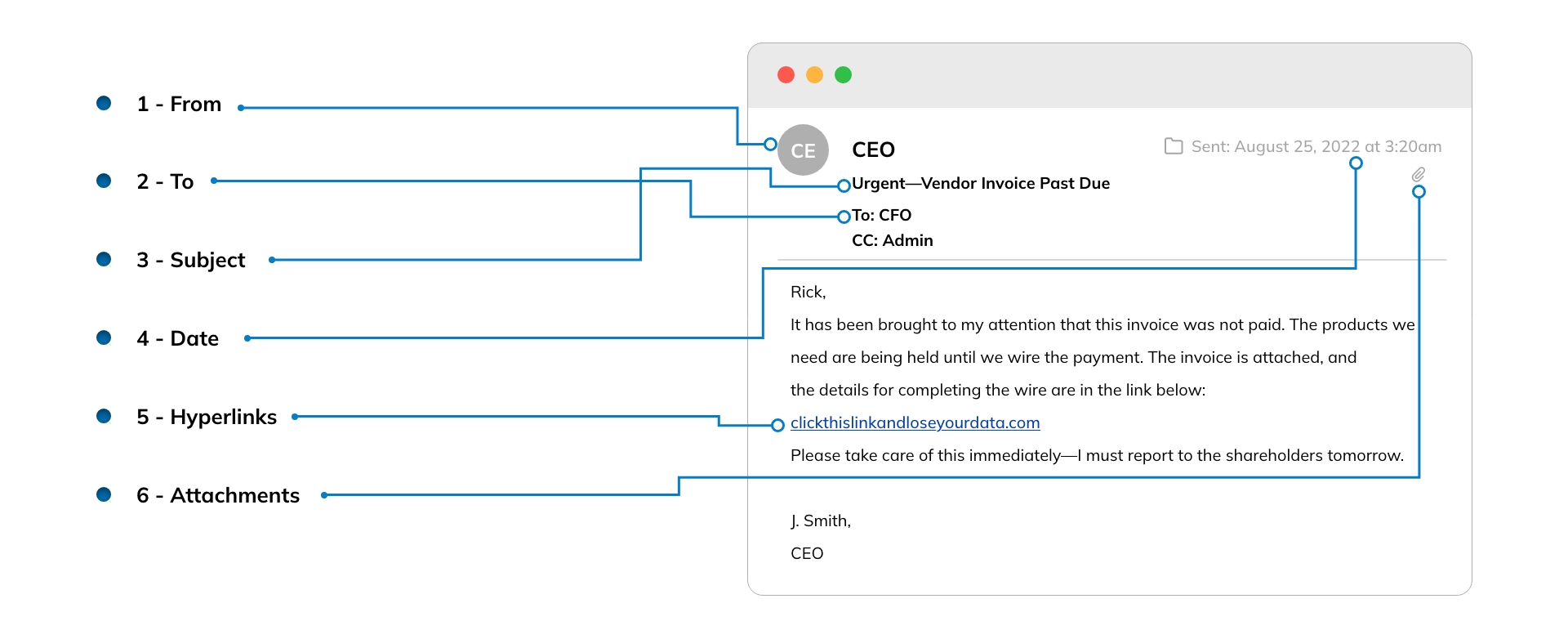
The ITeam Email Security Guide
Follow these steps before you click:
- Is the sender unfamiliar to you?
- When you hover over the email address, is it different than what appears in the header?
- Is the email out of character?
- Is the email from someone outside of your organization and asking you to do something outside of your typical role?
- Is the sender a stranger?
- Does the email include a link or attachment?
- Is the email being sent to multiple people that you don’t know?
- Was the email sent to multiple people within your organization who typically would not be cc’d on the same messages?
- Is your name spelled wrong?
- Does the subject line differ from the contents of the email?
- Does the email subject line have language quirks that seem out of place?
- Does the subject line say something that makes you panic or feel like something has gone wrong?
- Does it imply you must take action immediately?
- Was the email sent at an odd hour compared to when you received it?
- Is there a hyperlink included in the email?
- When you hover over (but don’t click) on the link, does it go to a different website?
- Does the hyperlink look similar to a legitimate website but differ slightly?
- Is there an attachment?
- Does the attachment end in anything other than .txt?
- Was the attachment unexpected?
- Did it ask you to enable macros?
Protect Your Calgary Business from Email-Based Threats
Email is the number one entry point for cyberattacks. The large majority of breaches start with a phishing message, and Calgary businesses across energy, professional services, healthcare, and the trades are frequent targets. The ITeam’s email security service combines advanced spam and malware filtering, anti-phishing protection, email encryption, and multi-factor authentication to keep your inboxes and your data secure.
We secure Microsoft 365 and Google Workspace with layered defenses: inbound and outbound filtering, impersonation and business-email-compromise detection, link and attachment sandboxing, and continuous monitoring. When a threat is detected, our Calgary-based team responds quickly to contain it before it spreads across your organization.
Technology alone is not enough, so we also train your staff to recognize phishing and social-engineering attempts. The strongest defense pairs the right tools with an alert team. We help you meet Canadian privacy obligations, including PIPEDA, with encryption and retention controls that protect sensitive client and patient communications.
Email Security FAQs
What is email security and why does my Calgary business need it?
Email security is the set of tools and practices that protect your email from phishing, malware, spoofing, and data loss. Because most cyberattacks begin with email, strong email security is one of the highest-impact protections any Calgary business can put in place.
How does The ITeam protect against phishing and business email compromise?
We deploy advanced filtering that detects phishing, impersonation, and business-email-compromise attempts, sandbox suspicious links and attachments, and enforce multi-factor authentication so a stolen password alone cannot compromise an account. We pair this with ongoing staff awareness training.
Do you secure both Microsoft 365 and Google Workspace email?
Yes. We harden and monitor both platforms, adding filtering, encryption, MFA, and alerting on top of their built-in protections to close the gaps attackers exploit.
Does email security help with compliance?
It does. Encryption, access controls, and retention policies help Calgary organizations meet PIPEDA and industry privacy requirements while protecting confidential information.